


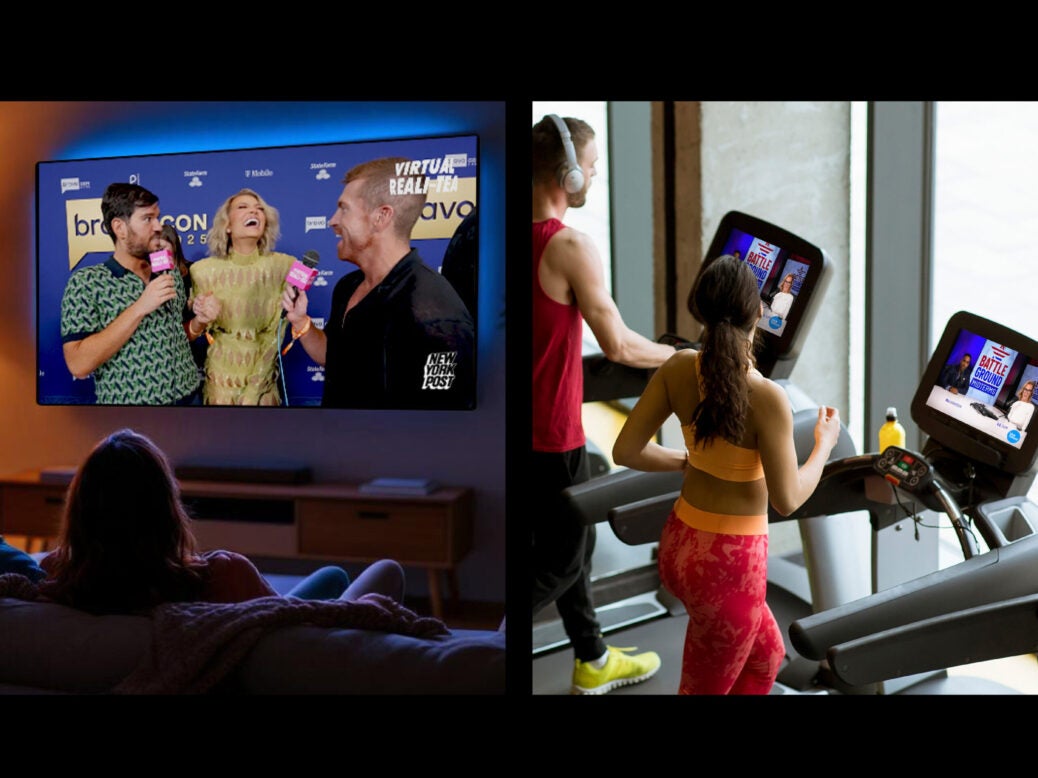
Publishers are missing out on potential revenue for their video content opened up by the growing ‘FAST channel’ and ‘digital out-of-home’ markets, which offer a TV audience and longer dwell times than found on mobile and social.
FAST channels – Free Ad-supported Streaming Television – is already a maturing market in the US, with channels run by the likes of Fox and Paramount, but is still “a growing opportunity” for digital publishers in the UK and Europe, according to experts at Video Elephant.
Digital out of home (DOOH) is broadly any screen not in a consumer’s home, or their personal mobile or tablet.
Not only does FAST include platforms such as Tubi and Pluto TV, but also channels that come free with Smart TVs and digital services from Samsung, LG, Amazon, and Roku, among others. All are free to use, funded by advertising, and stream 24/7.
Some FAST channels are specific to brands and their content, while others group licenced content around a single topic or genre, such as travel, horse racing, or action movies. Legacy print media titles The Guardian and the Washington Post have both launched their own FAST channels in recent years.
When FAST channels first launched over ten years ago, the content included “a lot of old stuff, a lot of B-roll”, said Johnny O’Neill, VP of customer success at Video Elephant, “but now, year over year, we’re seeing that content getting more refined, bigger brands coming in, and larger media organisations having FAST as part of their slate.”
FAST channels offer ‘bigger screens and longer dwell times’
Video Elephant has launched three of its own FAST channels – Real Crime Uncovered, Travel Escapes and Beyond Paranormal – and offers a management service to publishers making the move into streaming, with a dedicated team in Los Angeles. It now manages 12 channels, including for USA Today and the New York Post – the latter launching this year.
Based in the US and Ireland, its main business is as a video aggregator that licences video content to digital publishers and other companies, boasting a library of over six million news and entertainment videos across 16 languages, with thousands of new videos added daily.
Video Elephant, founded in 2012, works with digital publishers and content creators who either pay for a licence to use its extensive library of brand-safe content, or agree to syndicate their own content in exchange for a share in any revenue it generates.
“The way we look at it, there’s now a reality where you can repackage content into different formats and create new monetisation opportunities, as well as new audience opportunities,” said O’Neill, who’s been with Video Elephant since 2013.
“Particularly for large media companies and large established brands, this is a way to reengage your existing audience, but also identify new audiences. The value of FAST channels is obviously it’s on a bigger screen and typically we’re seeing longer dwell times, so we’re seeing people sit down and watch content for 45-50 minutes, which is not really the experience that most publications would get when they’re serving video through mobile or desktop – potentially on YouTube, but the economics of YouTube are quite different.”
O’Neill said Video Elephant’s goal was to help digital publishers to “repurpose, repackage, and identify new audience and monetisation opportunities for their existing content”, adding: “If there are other meaningful brands that have a FAST channel that maybe isn’t performing as well as it could, or don’t have a channel at all but have the content to, Video Elephant could be the conduit to getting that channel onto these platforms.
“That’s where we’ve seen the exponential growth in our streaming business – being able to take our expertise from launching channels but then apply that to a meaningful brand.”
Digital publisher should have ‘more of a streaming presence’
FAST channels opens up revenue for publishers from advertising video-on-demand (AVOD), with even Netflix and Disney Plus reincorporating pre- and post-roll advertising into their subscription offerings, showing ads are now baked in to the streaming model.
There is “a tolerance for customers to consume ads if it means their hard cost is going down”, O’Neill said. “I do see a very good path for large media companies to have more of a streaming presence and for potentially mid- to small-sized publishers to be a licenser into the space, because I will say you do need a lot of content for a FAST channel – we recommend around 200 hours to start off.
“The platforms typically dictate the refresh rate [of new content]. They’re going to want to see 20% refreshed over a monthly period, or something like that. So it’s quite an investment for a publisher if you’re not the size of the New York Post [and] already producing this.
“That’s why I think there are opportunities for people with archives and catalogues to licence into that space, because there is definitely a need for content there. [And] even though there are a lot of channels, there is still very healthy competition for premium [content].”
Digital Out-Of-Home is a missed revenue opportunity for publishers
But FAST is not the only growth market publishers might be missing out on when it comes to video content, with digital ‘out-of-home’ (DOOH) another area with “more room to grow”, according to O’Neill.
Video Elephant is focusing on TV screens in places in the US where people spend time, e.g. restaurants, bars, doctors’ or dentists’ offices, nail salons, etc., rather than the giant billboards or advertising screens seen in cities like New York and London.
“We want to focus on locations where people are watching the content… they may not be actively, totally engaged in the screen, but they’re very aware of it, they know it’s on, they may hear the sound,” said O’Neill. “That’s an exciting, growing space for us.”
Unlike streaming, DOOH engages an ephemeral audience, with a dwell time in a physical location rather than a digital one, and the content demand is far lower, with content able to be repeated once an audience has moved on, unlike rolling FAST channels. But a DOOH screen’s location can vary wildly, from an independent store to a corporate chain.
“It’s a format that’s really finding its footing,” said O’Neill, who is clear that FAST channels and DOOH are “the syndication opportunity writ large” for digital publishers.
‘Streaming is an opportunity every publisher should try to participate in’
“A FAST channel isn’t going to be for every publisher,” he said. “It makes a lot of sense for someone who is niche and is very focused on a specific thing, because that can cut through a lot of the noise, and it makes sense for a large brand that has name recognition, because that’s going to resonate with an audience.
“It’s very hard for a small, lesser-known publisher to try and break through onto TV unless they have a real hook, but that’s not to say that that content can’t be licensed into other channels. I do think that streaming in general is absolutely an opportunity that every publisher should be trying to participate in, whether that’s as a content distributor or building out their own asset.
“We think Digital Out-Of-Home is a big opportunity, particularly in the US. We’re working with 200,000 or so digital screens all across the country – like bars and restaurants and doctors’ waiting rooms – and we’ve been able to find distribution opportunities for content, both short form and long form, into those environments. So that’s something we’re quite bullish on.
“Where previously it was just a cable plugged in, now there’s an option for the owners of these establishments to connect their screen to the internet and run [licenced] content, ads, their own content, so we definitely see that as a growing opportunity. For digital publishers, that’s something that very few would be really aware of or even exploring.
“Distribution of and syndication of existing video content is a missed opportunity, to a greater or lesser extent, for publishers and that’s definitely the area and the problem that we’re trying to solve.”
Why podcasts are ‘perfect’ for video
O’Neill said digital publishers “have to do it all” when it comes to video strategy, from social to streaming, with video now something that “spans across a publisher” – the ‘pivot to video’ having been largely forced on publishers with the advent of social media platforms like TikTok and Instagram, which have prioritised video content.
However, digital publishers can work smarter to “get the same message out across multiple platforms,” O’Neill said, pointing to those working with Video Elephant who produce a longer format show then cut it for web and social, and even transform it into vertical video.
“I think that’s probably the optimum,” said O’Neill. “Someone needs to be thinking about how [this content] can be best utilised across different distribution points and audience segments.” In this regard, he said the video podcast was “perfect”.
“The majority of meaningful publishers are probably in the podcast game already and videoing that podcast just unlocks so much more value, because then straight away that can go to streaming, that can go to YouTube, that can be cut for social,” said O’Neill.
“We see as a massive development in what’s going on in video. I think you’re going to see a lot more publications do that.”
Visit videoelephant.com for more.
Email pged@pressgazette.co.uk to point out mistakes, provide story tips or send in a letter for publication on our "Letters Page" blog
